
AI Agents vs. Chatbots
AI Agents vs. Chatbots: What’s the Real Difference?
AI AGENTSCHATBOTS
11/13/20252 min read
AI Agents vs. Chatbots: What’s the Real Difference?
In the fast-evolving world of artificial intelligence, terms like AI agents and chatbots are often used interchangeably. Yet, while they might seem similar on the surface, the distinction between them is crucial—especially for businesses looking to enhance customer experience, automate operations, or build smarter digital products.
What Is an AI Agent?
An AI agent takes automation several steps further. Instead of following fixed scripts, an AI agent uses advanced models (like GPT-5 or similar architectures) to reason, plan, and act autonomously toward a goal.
Where a chatbot merely responds, an AI agent can decide what to do next.
AI agents can:
Access real-time data and external tools (APIs, databases, CRMs)
Perform multi-step reasoning to solve problems
Learn and adapt from user interactions
Take initiative (e.g., schedule a meeting, create a report, or adjust marketing campaigns)
Think of AI agents as digital co-workers rather than digital assistants.
Examples of AI agents:
An autonomous sales agent that qualifies leads and books calls
A virtual marketing strategist that analyses campaigns and adjusts budgets
A project management AI that tracks progress, assigns tasks, and alerts teams
Key traits of AI agents:
Dynamic and context-aware
Multi-step reasoning and decision-making
Goal-oriented, not just response-oriented
Integrates across platforms and data sources
In essence: AI agents are proactive and adaptive problem-solvers.
What Is a Chatbot?
A chatbot is a conversational interface designed to simulate human dialogue—most often through text or voice. Think of those familiar website chat windows that help you reset a password, answer FAQs, or connect you with support.
Chatbots are typically rule-based or flow-based, meaning they follow predefined scripts or decision trees. When a user types a question, the chatbot matches it against a database of expected inputs and provides the most relevant answer.
Examples of chatbots:
Customer service assistants on e-commerce websites
Facebook Messenger bots for marketing
Voice assistants that follow limited commands (“What’s the weather?”)
Key traits of chatbots:
Limited contextual understanding
Predefined conversation paths
Ideal for repetitive or transactional interactions
Quick to deploy, low maintenance
In short: Chatbots are task-specific and reactive.
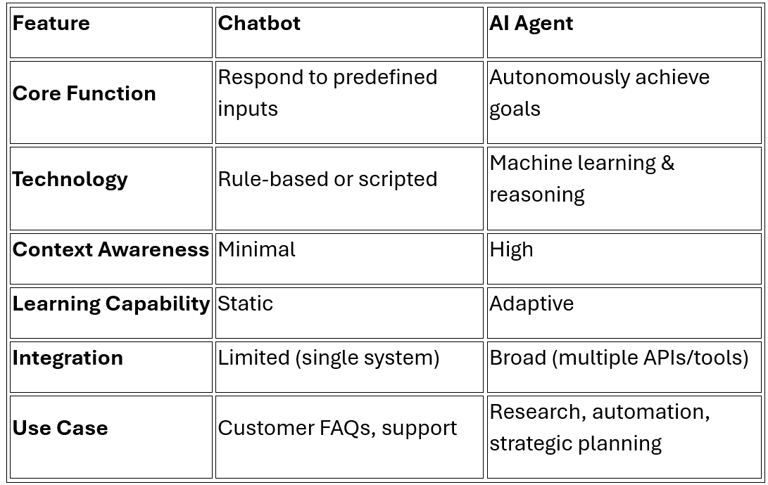
Chatbots vs. AI Agents: Side-by-Side Comparison
Why AI Agents Are the Next Step for Digital Businesses
Modern digital businesses are moving beyond chatbots. While chatbots handle routine interactions efficiently, AI agents bring intelligence, context, and autonomy—key ingredients for delivering personalised, efficient, and scalable customer experiences.
For agencies and enterprises, AI agents can:
Save hundreds of hours in operations
Deliver data-driven insights automatically
Improve lead conversion and retention through personalisation
Act 24/7 with minimal supervision
Final Thoughts
Chatbots are the foundation; AI agents are the evolution.
If chatbots are digital receptionists, AI agents are digital employees—capable of understanding, deciding, and executing. As generative AI and agentic systems mature, businesses that adopt AI agents early will have a major competitive advantage in automation, customer experience, and decision intelligence.
Digital Solutions
Empowering your health & beauty business growth.
Contact
+44 (0)7739 401 556
© 2025. All rights reserved.